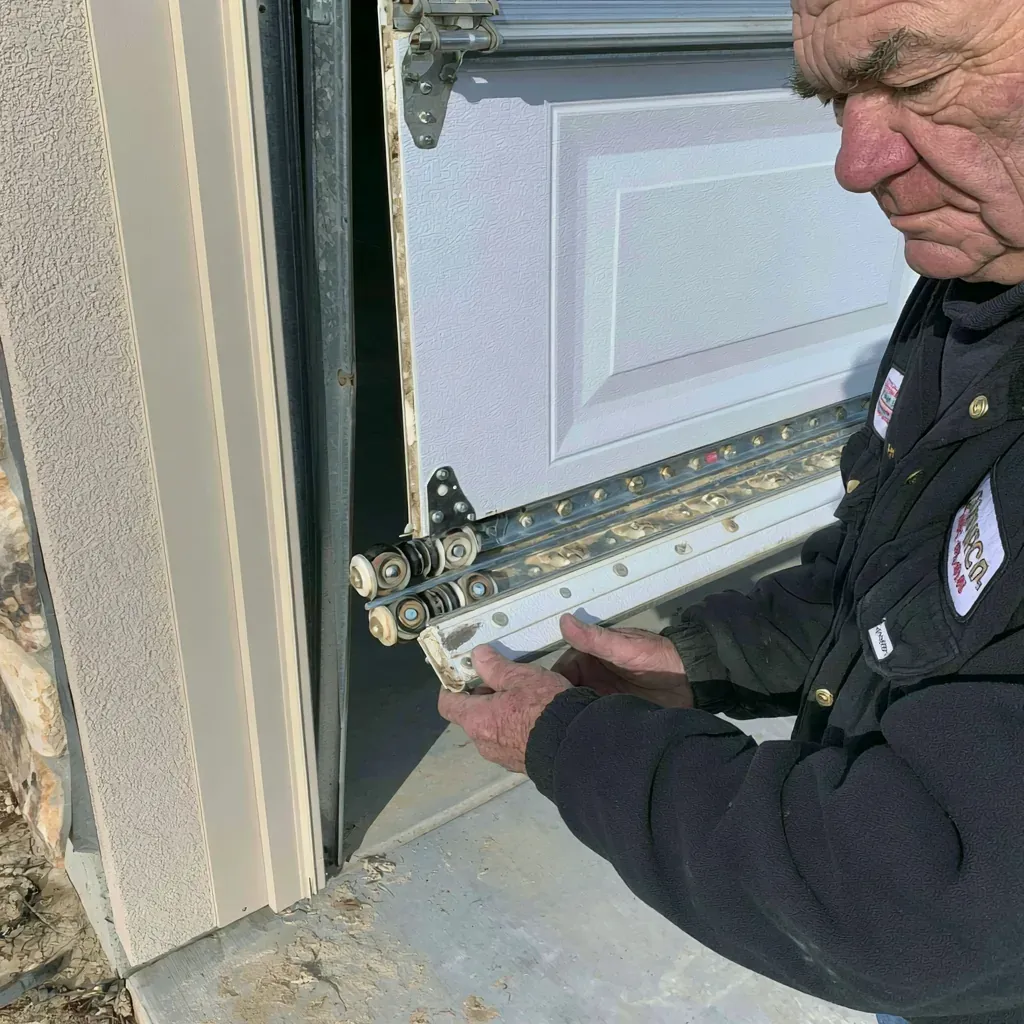
Dry Wind Finds Every Loose Part
Chula Vista streets west toward the bay pick up fine salt film that dries into the bottom track, while grit off driveways near Hilltop and Otay settles into the same channel. Either one narrows the rail at one spot until a roller catches there every cycle.
Track brackets in Eastlake and Rolling Hills Ranch garages, mostly built from the 1990s on torsion hardware, can work loose from ordinary cycling over the years. A bracket that creeps away from the jamb lets the rail flex at that one point and grab.
Panels facing strong afternoon sun near the Sweetwater River corridor take more UV and heat cycling than panels on a shaded north wall, and the paint and seals go first. A door that still opens fine can be quietly drying out and cracking at the seams for years before it shows.
When Grading and Slopes Move a Slab
- Pattern
- Catches, shudders, or grinds at one fixed spot every cycle, not spread along the rail.
- Cause
- Salt film or dust packed in the bottom track, a bracket pulled loose from the jamb, or a jamb edging out of true.
- Risk
- Gets sharper and louder over weeks as grime builds; almost never clears up on its own.
- First Check
- Roller and track wall right at the catch point, then bracket screws and jamb alignment behind it.
- Left Alone
- A cable jumping off the drum, or the door hanging crooked in the opening at that panel.
- Timing
- Near the water, salt film thickens fastest through the wetter months from November into March, when damp mornings keep the slab moist. Farther inland past Interstate 805, dry summer dust does the equivalent work more slowly across the year.
- Site Visit
- an estimated $159–$649
What the Grading Under This Slab Is Doing
An opener limit fault or a weak spring can stop travel without creating one physical catch point. Those faults may reverse near an end position or let the door sink after release. Binding repeats where the same roller reaches the same rail section, often with a scrape or shudder at that spot. Run one full cycle and watch the exact spot where it happens. A door that catches at the identical mark every pass and then continues is binding. A door that stalls short and reverses, or drops the last few inches when you let go, points to the opener or the spring instead.
Reading the Bay Air on Your Hardware
The door hangs up at the same inch every cycle, which points to that spot, not the whole track. Dust off Otay Valley Road builds on the rail; a bracket loosened by vibration lets the rail flex; a jamb near the slab shifted. The licensed pros we connect you with check that fixed point first, before assuming the track itself is bent.
They also cycle the door in full to see if it stalls or the door reverses before it closes at that same mark, since a safety sensor light blinking out of alignment can mimic a bind that is really in the hardware.
A garage door in Chula Vista opens and closes on the same springs and cables whether the house sits near the bay or up on a graded hillside mesa, and each cycle wears those parts a little more. Age and use matter more than any single weather event, which is why a door that worked fine last month can fail without warning this one.
HOW SLAB MOVEMENT ON GRADED GROUND AFFECTS TRACKS
| What's Behind It |
Next Step |
|---|
| Small imbalances compound quietly. A cable that has stretched a few millimeters or a bracket that has shifted throws off the geometry just enough that the door starts favoring one side, and that uneven wear accelerates until the whole run needs attention at once. | Cables fray, sensors drift, and hardware loosens gradually enough that most people adjust to it rather than notice it. A door still opening every morning can be a week from cable failure. The gap between working and working safely is where the real risk sits. |
| Streets near San Diego Bay carry salt in the air every day of the year, and it works on unpainted spring coils and roller stems long before a homeowner notices anything wrong. A door that rolled quietly all summer starts groaning by fall. Coated cable and sealed bearings cost more up front and earn that cost back near the water. | Small issues rarely stay small. A roller that squeals or a cable that frays keeps working until it doesn't, and the door that seemed fine last month is the one stuck halfway up this month. Catching that drift before it becomes a stuck door is the whole point of a scheduled look. |
| Hardware bolted near an alley-loaded or detached garage sees more temperature swing across a single day than hardware tucked against the house, since it sits exposed on more sides. That daily flexing loosens fasteners and dries out lubrication faster than the manual's service interval assumes. | A spring rarely announces itself. It carries the door's full weight quietly, cycle after cycle, until corrosion and metal fatigue reach a point where one more lift is the one it can't finish. The pros we connect you with replace both springs together and reset the balance, since a mismatched pair strains the opener within months. |
Reading The Door Before You Touch It
Watch for one repeated catch point rather than a drag along the whole rail. Wipe visible dust or salt film off the bottom track with a dry cloth and see if the hitch eases. If a remote not working or the door dropping when you let go shows up too, stop and call.
What a License Actually Covers Here
Every forced cycle pushes the affected roller harder against the rail and transfers that resistance into the panel, cable, brackets, and opener. The catch can deepen, a bracket can loosen further, or a cable can leave its drum. Stop once the same hesitation appears again rather than powering through it.
Worth repairing or time to replace?
Treating door binding in the tracks usually runs an estimated $159 to $649. That is a budgeting figure, not a price. This range assumes a standard sectional door on a residential opening and covers the spring, cable, roller, opener and panel work rather than a full replacement. A wider or insulated door, or one on an older out-of-square opening west of Interstate 805, sits above it. Looking at the door costs nothing and the figure is written down before anything starts. Full bands and what moves them are on the pricing guide, and the service that handles this is Off-Track Garage Door Repair.